The Challenge
Universidad Nacional de Río Cuarto (UNRC) aimed to deliver high-quality online education to over 10,000 students simultaneously. While Jitsi is easy to deploy, scaling it to support such a large number of concurrent users without compromising performance and interaction quality posed a significant challenge. UNRC required a robust and scalable infrastructure capable of handling peak loads while ensuring uninterrupted learning experiences.
Our Approach
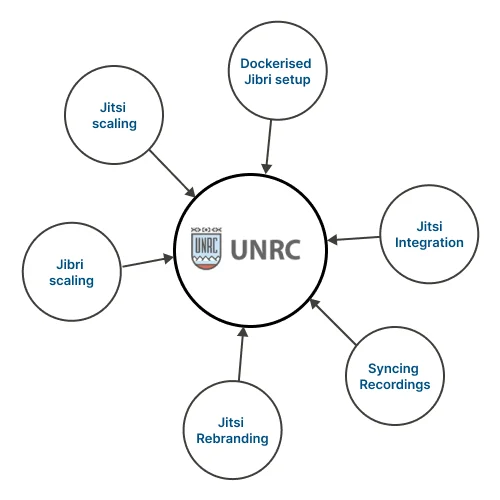
To meet UNRC’s ambitious requirements, we designed a customized Jitsi solution tailored for large-scale educational use. We deployed Jitsi on-premises to give UNRC full control over their infrastructure and data, along with complete rebranding to align with their institutional identity.
We implemented a multi-cluster Jitsi architecture to distribute load efficiently and ensure system resilience. This approach allowed the platform to maintain high performance even during peak usage by thousands of concurrent users.
For recording capabilities, we deployed a dockerized Jibri setup that enabled scalable and reliable recording of lectures. This ensured that thousands of sessions could be recorded simultaneously without performance degradation.
To enhance accessibility and security, recorded sessions were synchronized across servers using SFTP, ensuring that content remained both secure and easily accessible to students and faculty.
Additionally, we integrated Jitsi seamlessly with UNRC’s existing systems, enabling a smooth transition for users and minimizing the learning curve for both students and educators.
- On-premises Jitsi deployment with full rebranding
- Multi-cluster architecture for high scalability and resilience
- Dockerized Jibri setup for large-scale recording
- Secure recording synchronization via SFTP
- Seamless integration with existing university systems
The Result
The implemented solution enabled UNRC to successfully host over 10,000 concurrent students with a seamless and interactive online learning experience. The scalable architecture ensured stable performance during peak usage, while the robust recording system supported continuous learning through recorded lectures. This transformation allowed UNRC to deliver high-quality education at scale, positioning them for the future of digital learning.