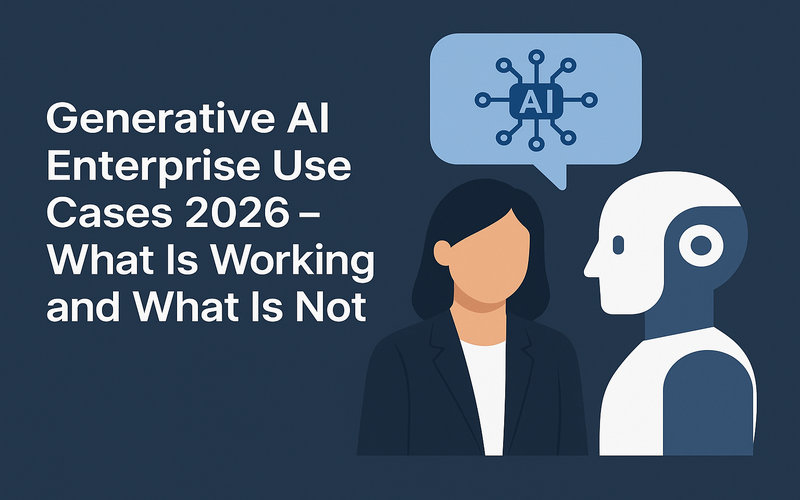
The enterprise generative AI landscape in 2026 — from experiments to production
By 2026, many companies have moved past just testing out generative AI. Initially, they toyed with big language models, image creation, and coding tools—but now, it’s front and center in their daily operations. This isn’t about research or isolated tests anymore; it’s about solid, real-world success stories.
Generative AI can whip up new content—like text, visuals, code, or data—by learning from data patterns instead of simply retrieving information or following set rules. This capability allows for automating previous manual and slow tasks. As model structures, integration features, and scalability have improved, businesses now count on AI to add real value.
But rolling this out isn’t just about having the right tech. Companies need to tackle data guidelines, ethical questions, human checks, and clear evidence of return on investment. The conversation has shifted: it’s not if we can use generative AI, but how do we get the best value while managing risks?
iTechNotion has been actively guiding companies through this transition, helping them assess readiness, develop AI strategies tailored to their needs, and implement solutions aligned with their business goals. For instance, in 2025, we set up a multi-department generative AI platform for a big retailer, streamlining work between content creators, customer support, and data analytics, all with human oversight to keep quality and compliance in check.
Use cases that are delivering measurable ROI today
Not all uses of generative AI bring in the same returns. The ones that stand out either save a lot of time or directly boost revenue. Based on industry info and our projects at iTechNotion, here are some AI applications making waves in 2026:
- Automated content creation that speeds up the output for marketing and internal communication without losing quality.
- Code generation tools that bump up developer efficiency and shorten the time to launch.
- Improved customer support with AI-driven personalized responses and automated chat services.
- Data extraction and summarization from huge piles of unstructured info like documents, emails, and logs.
- Tailored sales outreach using AI insights to personalize messages.
Early users report seeing operational efficiency and revenue growth go up by 15% to 30%. Such success stories push AI adoption as a key component in business strategy.
Content and knowledge management — internal search, documentation, policy generation
One of the top enterprise AI situations in 2026 revolves around content and knowledge management. Businesses are often juggling with organizing, finding, and updating massive chunks of internal knowledge. Doing it by hand? Too slow, and things become obsolete fast.
Making internal search smarter
Generative AI enhances internal search by grasping context and intent beyond simple keyword matching, providing more precise and relevant results for employee inquiries.
Auto-generated documentation and policy drafts
AI models can draft policies, standard operating procedures, and technical documentation. Recently, iTechNotion paired with a financial firm to automate policy drafting, cutting down the writing turnaround from weeks to mere days while keeping compliance intact, allowing rapid revision.
This method lets experts concentrate on reviewing and enhancing content rather than starting anew. It also helps maintain uniform language and tone throughout documents.
Code generation and developer productivity — what teams are actually saving
Developers reap significant benefits from generative AI for building boilerplate code, writing unit tests, and suggesting complicated function logic, which speeds up delivery cycles and minimizes repetitive coding chores.
Real impact on teams
A mid-sized software firm collaborating with iTechNotion incorporated GPT-based code assistants into their processes, witnessing a 20% decrease in coding time per sprint and fewer early-phase bugs, enabling faster product launches and better resource management.
Balancing AI with human judgment
It’s vital for teams to thoroughly verify AI-generated code. While these tools speed up creation, errors or inefficient logic can slip by unnoticed without review. Companies get the best ROI when combining AI help with rigorous code review best practices.
Customer experience — personalized responses, support automation, onboarding
Generative AI shakes up customer experience plans across sectors. Automated, custom responses mean support teams can manage more inquiries while maintaining top-notch quality.
Support automation
AI-driven chatbots manage tier-one questions, allowing human agents to focus on complex cases, reducing wait times and boosting satisfaction.
Personalized customer interactions
With AI insights, companies tailor communications, product recommendations, and onboarding experiences to fit individual customer needs. iTechNotion aided a telecom provider in deploying such a system, improving customer retention by 12% in six months.
Data analysis — turning unstructured data into structured insights at scale
Businesses generate a mountain of unstructured data daily—from emails, documents, social chatter, customer feedback. Generative AI excels at extracting valuable insights from this chaos.
Summarization and trend spotting
AI aids in efficiently summarizing key points and spotting patterns across data sets for faster decision-making.
From chaos to structure
Through text parsing and data normalization, generative AI supports advanced analytics and reporting, helping marketers, analysts, and compliance teams work smarter, not harder.
Sales and marketing — personalized outreach, content creation, market research
Sales and marketing teams harness AI power to create personalized messages, generate campaign content, and streamline market intelligence efforts.
Tailored outreach at scale
AI sifts through customer data to craft emails and proposals that hit home with prospects, improving conversion rates.
Speedier content creation
Blogs, social media updates, and ad copy—faster and more consistent than ever.
Market insights
Generative AI helps teams identify new trends, competitor moves, and customer sentiments, allowing for real-time strategy adaptations.
Use cases that are still not reliable enough for production — honest assessment
Despite advancements, some generative AI business use cases face hurdles preventing full-blown implementation.
Fully autonomous decision-making
AI models lack the context-awareness and ethical judgment needed to independently make business decisions safely.
Creative design requiring subtlety
Although generative AI can produce art and media, creativity requiring originality, style, and brand alignment remains human-driven.
Document drafting in legal and compliance
Errors here can be costly. AI-generated legal text demands expert review and isn’t yet trustworthy for complex contracts or compliance tasks alone.
These hurdles highlight the ongoing need for cautious, human-focused AI enterprise strategies.
The governance and compliance layer — what enterprises are getting right
Successful companies view governance and compliance as key components in effectively using generative AI.
Clear guidelines and risk management
Businesses set acceptable use policies, data privacy rules, and audit trails to steer clear of liabilities and biases.
Consistent monitoring
Real-time AI output oversight catches issues early. iTechNotion’s governance frameworks incorporate these safeguards to adhere to industry regulations.
Human-in-the-loop strategies
Incorporating human supervision ensures quality and accountability, especially in sensitive applications like customer service or legal content.
How iTechNotion approaches enterprise generative AI implementation
At iTechNotion, we kick off with a thorough look at your organization’s readiness and objectives. We then craft strategies aligning tech with business priorities and risk willingness.
We plan staged rollouts, starting with impactful, low-risk generative AI use cases. Our teams aid with data prep, model integration, and change management for smooth adoption.
Our governance framework stresses transparency, compliance, and ongoing improvement. Throughout, we prioritize human collaboration with AI to amplify strengths while managing risks.
For example, our work with a large energy company resulted in deploying AI for knowledge management and customer support automation, achieving 25% quicker issue resolution, better employee satisfaction, and compliance alignment.
We believe clear metrics and honest assessments drive ongoing success in generative AI enterprise use cases for 2026.
Conclusion
Generative AI in businesses isn’t just a futuristic fantasy—2026 shows its value across various areas. From managing content and increasing developer productivity to enhancing customer experience and data insights, proven applications provide real ROI. Yet, some ambitious use cases are harder nuts to crack due to reliability, governance, and ethical concerns.
CTOs and tech leaders must juggle innovation with caution. Picking the right use cases, solid governance, and encouraging human-AI teamwork are key to success. With partners like iTechNotion, companies can confidently navigate the ever-evolving AI landscape.
Want to see how generative AI can revolutionize your business? Contact iTechNotion today for a strategic consultation tailored to your needs.