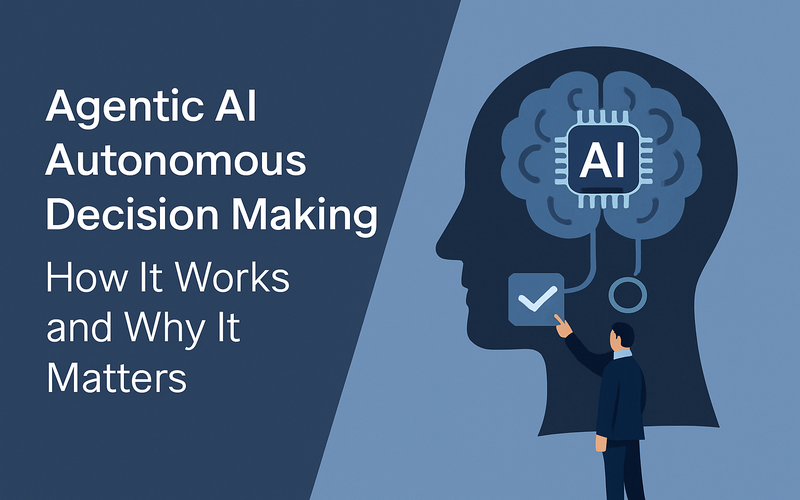
If you're a CTO or tech leader, getting a grip on agentic AI's decision making is a must these days. This isn't just basic automation. These AI agents can see what's going on around them, think through their options, make a plan, take action, and then check how it all went—without anyone having to hold their hand.
We’re breaking down what making decisions with AI looks like today. Forget the sci-fi stuff. We’ll show you how these AI agents do the job, what sets them apart from rigid rule-based systems, and where they shine or where you better keep a close eye on them. Expect some insights from industry experts and how iTechNotion gets these smart agents to work without causing chaos.
What autonomous decision making means in the context of AI — not science fiction
When we talk about autonomous decision making in AI, we mean software that gets through decision cycles with little to no help from people. It’s nothing like scheduled tasks. These agents react to new info and surroundings.
So, no robots are taking over here. It’s software deciding smartly within set limits. For instance, an AI routing customer service inquiries based on how tricky they are and who's available is using agentic AI decisions. They keep learning from their environment, adjust on the fly, and get priorities right.
Such AI systems lean on complex reasoning and planning. They take in data, imagine what might happen, and pick the best next moves. The trick is in their fast-thinking loop from observing to assessing, ready for changing situations.
The decision loop — observe, reason, plan, act, evaluate
A typical agentic AI workflow runs on a recurring decision loop of five steps:
- Observe: The agent collects data from sources like sensors or databases about the current scene.
- Reason: It analyzes this info, spots possible actions, and foresees outcomes using logic or probability.
- Plan: It figures out the steps needed, keeping constraints and goals in mind.
- Act: Executes the plan by activating commands or processes.
- Evaluate: Watches the results to confirm everything went well, identifies mistakes, or learns from surprises to improve future actions.
This loop can be lightning-fast for real-time systems or take its time in business contexts. Its power is in its ability to keep self-correcting, letting the agent adapt to changes without waiting for human directions.
How AI agents handle uncertainty and incomplete information
Real-life conditions are often unpredictable and messy. AI shines when it's good at handling partial, messy, or unclear info. They use things like probabilistic reasoning and fuzzy logic to gauge unknowns and balance risks.
If an autonomous AI is evaluating credit risk without full customer details, it relies on statistical models to guess the repayment likelihood. It might even run multiple scenarios to brace for different outcomes.
Being adaptable matters. Lots of agents use reinforcement or online learning to up their decision game over time, countering incomplete data’s chaos without needing everything spelled out from the start.
Rule-based vs learning-based decision making — the difference
Rule-based decision making
This method sticks to clear if-then rules crafted by experts. It's straightforward, clear, and dependable for known cases.
Rule-governed systems thrive on predictable, repeatable tasks where the rules don't change much—think compliance checks or simple routing tasks. But when things get complicated or uncertain, rules might crumble.
Learning-based decision making
Learning-based AI figures out its game plan from data via machine learning. These agents apply past examples to improve over time.
This style suits dynamic settings, like supply chain tweaks or scam detection, where patterns shift. Though not as straightforward as rule-based methods, learning models brag about adaptability and flexibility.
Often, agentic AI systems blend both methods. Rule-based pieces keep things safe, while learning models manage complex reasoning.
Where autonomous decisions are safe vs where human approval is essential
Not every decision should be fully autonomous. Businesses must assess the risk, impact, and regulatory context to assign decision rights.
Safe autonomous decisions typically include:
- High-volume, low-impact tasks: e.g., automatically sorting customer support requests or placing routine inventory orders.
- Rapid decisions requiring scale: e.g., real-time credit scoring or sending targeted marketing promos.
- Scenarios with clear boundaries: e.g., alerting for system health changes.
Human approval remains critical when:
- Decisions involve legal, ethical, or safety matters.
- They carry significant financial risk or binding commitments.
- Nuanced judgment is required, reaching beyond AI's present skills.
For tech leaders, combining autonomous decision-making with human checks optimizes speed, accountability, and reliability.
Real examples — financial analysis, customer service routing, supply chain decisions
Financial analysis
AI systems dig through loads of market data, autonomously spotting investment chances or risks. Hedge funds and finance giants rely on AI for trade execution based on patterns and risk models.
Customer service routing
Loads of businesses use AI for smart ticket routing, directing them to suited agents without a hitch. This cuts wait times, upping resolution rates by automating those easy decisions.
Supply chain decisions
AI agents tweak stock levels on the fly, choose suppliers, and reroute shipments based on real-time insights, keeping operations lean and cost-effective.
iTechNotion’s AI systems are woven into enterprise setups. In supply chain management, their decision-savvy agents keep tabs on logistics, adapt to delays, re-route shipments, and check results for smoother processes with minimal human effort.
Governance and oversight — how businesses maintain control of autonomous AI
Running autonomous AI at scale calls for solid governance. This includes open auditing, well-defined roles, and safety mechanisms.
Best practices involve:
- Setting limits on how much autonomy is granted, based on risk checks.
- Keeping detailed logs for tracking decisions.
- Embedding fail-safes to pause or reverse automated actions if hiccups arise.
- Ongoing reviews with consistent monitoring using dashboards and alerts.
Guidelines like AI Governance Principles from IEEE or NIST help in setting responsible deployment rules.
At iTechNotion, they bake governance right into the designs. Building guardrails, they enforce compliance and offer human overrides to make sure AI decisions align with company policies and ethics.
How iTechNotion builds decision-capable agents with appropriate guardrails
iTechNotion combines AI smarts with deep industry know-how to craft bespoke autonomous agents for companies. Their process includes:
- Requirement Analysis: Grasping the decision context, risks, and goals.
- Hybrid Architecture: Merging rule-based safety barriers with adaptable machine learning.
- Iterative Development: Crafting and testing each decision loop block for surefire reliability.
- Governance Integration: Plugin audit trails and human checks.
- Continuous Improvement: Tweaking decisions based on real-world feedback to get them just right.
This method ensures autonomous systems are both potent and trustworthy—scaling automation without losing command. iTechNotion’s seasoned experience shows how AI can reshape enterprise workflows safely.
Conclusion
Agentic AI's autonomous decision making hands tech leaders a huge advantage in automating complex choices at scale. Understanding the decision process, managing uncertainty, and balancing autonomy with human oversight are key to harnessing this power.
By blending rigid rule-based systems with flexible learning models, companies can let AI up their efficiency, cut errors, and adapt to change. However, locking in strong governance and realistic boundaries is critical to managing risks.
With established frameworks and expertise, iTechNotion helps organizations build autonomous agents tailored to their needs, pairing breakthrough tech with responsible design.
Curious how agentic AI can transform your decision-making workflows? Contact iTechNotion today for a consultation tailored to your tech strategy and autonomy ambitions.