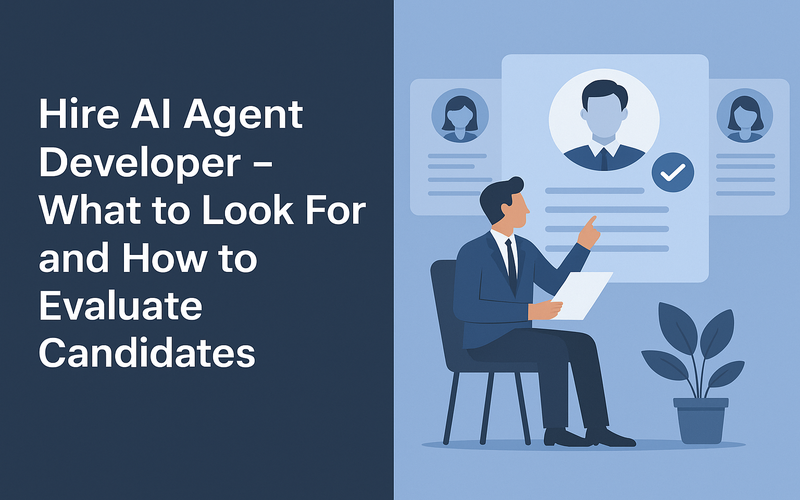
In 2026, finding AI agent developers isn't easy because demand way outstrips supply. Business leaders hunt for talent that seems impossible to catch. This piece breaks down the must-have skills, key tech stacks, and hiring options like freelancers, agencies, or in-house teams while guiding you on how to effectively evaluate candidates.
1. The talent shortage reality — why AI agent developers are hard to find in 2026
Autonomous AI agents are hot stuff, thanks to LLMs and smart frameworks. The catch? Everyone wants experienced developers, but they're few and far between. Many are still in the world of traditional AI or data science, yet Agentic AI requires hands-on pros who’ve built complex systems that stand on their own, interact smoothly, and continuously learn from user feedback.
The talent gap means you can’t just wing it when hiring. Finding candidates with real success in creating AI agents is rare, so careful evaluation is crucial.
2. What skills a real AI agent developer needs — beyond Python and prompt engineering
Sure, Python skills and prompt engineering matter, but they're just the start. Here’s what really sets top AI agent developers apart:
- Architectural design skills: They know how to build modular and scalable agents ready for failures and on-the-fly training.
- Experience with autonomous agents: They've got how autonomous systems juggle tasks, set goals, and handle lengthy interactions down pat.
- Deep understanding of vector databases: They're adept in semantic search and embedding storage, ensuring robust agent memory and context.
- Integration skills: They smoothly connect AI agents with APIs, databases, and platforms, keeping everything secure and seamless.
- Knowledge of modern AI frameworks: They work effortlessly with frameworks like LangChain, LangGraph, AutoGen, CrewAI for orchestration.
- Strong problem-solving: They're pros at debugging complex behaviors, optimizing responses, and tuning performance.
Real pros focus on creating systems, not just coding in isolation.
3. The tech stack to look for — LangChain, LangGraph, AutoGen, CrewAI, vector databases
Tech skills matter, and your AI agent developer should be hands-on with this stack:
LangChain
An open-source gem for crafting AI agents linked through language models, APIs, and data—it handles memory, routing, and more.
LangGraph
Think graph-based orchestration; it manages dependencies and interaction flows among agent modules.
AutoGen and CrewAI
These platforms boost collaboration and task delegation in multi-agent settings—making collective intelligence a breeze.
Vector Databases
Agent memory thrives on vector stores like Pinecone or Weaviate, with skilled handling of embedding and searches for similarities.
Find developers with actual project experience using any of these tools. At iTechNotion, LangChain piped over Pinecone brought a 40% user response improvement for a Fortune 500 firm.
4. Freelancer vs agency vs in-house — pros, cons, and cost comparison
Choosing who to hire is as critical as the talent you’re eager to bring on board.
Freelancers
Pros: They’re budget-friendly and flexible, excellent for small projects or prototypes.
Cons: There’s higher risk, less accountability, and potentially slower turnaround with scaling limits.
Agencies
Pros: They bring vetted experts, deliver project management, and offer reliability with faster kick-offs.
Cons: Typically, they cost more up front compared to freelancers, but deliver cost-efficient results in the end.
In-house teams
Pros: You have control, keep resources long-term, and they align with your company culture beautifully.
Cons: They're costly, including salaries and benefits, slow to hire, and come with management duties bundled in.
Cost comparison
Usual hourly rates in 2026:
- Freelancers: $50-$100/hour
- Agencies: $120-$250/hour (includes project management)
- In-house: $150,000-$250,000/year per developer (plus overhead)
iTechNotion provides a smart balance—dedicated AI agent developers seamlessly within your team, and transparent pricing that hits a sweet spot between agency and freelancer benefits.
5. Interview questions that separate real AI agent developers from generalists
If you want to recruit top AI agent engineers, ask about:
- Share a project where you crafted an autonomous AI agent. What were the stumbling blocks you tackled?
- How do you use vector databases in AI agent memory? Name different similarity search methods.
- Describe your process using LangChain to coordinate multiple models or tools.
- What’s your method for debugging agent failures or unexpected quirks?
- How do you ensure secure API integrations within AI agents?
Good candidates will offer concrete examples and show understanding with technical details.
6. What a realistic project scope looks like — timeline and cost expectations
Projects differ vastly in complexity. A medium-sized customer service AI agent project may look like this:
- Timeline: 3 to 6 months from start to finish
- Phases: Gathering requirements, architectural design, development, testing, and rollout
- Team: 1-2 AI agent developers, a project manager, and occasionally a UI/UX designer
- Cost: $50,000 to $150,000, scaled by features and integrations
Costs skyrocket with complexity—think multi-agent coordination, real-time learning, or accessing multi-domain data.
At iTechNotion, we offer clear scopes and pricing. For instance, we created a multi-agent research assistant under $120,000 in 4 months—boosting client data retrieval by 55%.
7. How iTechNotion provides dedicated AI agent developers for client projects
iTechNotion boasts over 14 years of experience with 1500+ completed projects. Agentic AI is our core passion, led by Avkash Kakdiya, a well-known AI expert. We offer:
- Dedicated AI agent developers: Experts in LangChain, vector databases, AutoGen, etc.
- Clear project management: Agile work methods and straightforward communication
- Proven delivery: Demonstrated client success with solid ROI
- Flexible engagement: Options from pilots to full builds
- Post-delivery support: From maintenance to iteration and scaling
This ensures you secure experts who grasp your business needs and deliver on them fast.
8. Getting started — what information to prepare before your first conversation
Make the most of your first chat with iTechNotion or any AI agent developer by preparing:
- Project goals: Outcomes you’re seeking with the AI agent
- Use cases: Major scenarios or workflows for the agent
- Data sources: APIs, databases, or info the agent will tap into
- Technical constraints: Specific platform or security needs
- Budget and timeline: Your preferred delivery parameters
Being detailed helps in tailoring recommendations and delivering accurate estimates.
Seek partners who really get the nuances of AI agent development. iTechNotion’s rich experience, tried-and-true frameworks, and clear process mean you hire AI agent talent with confidence.
Contact us today to discuss your AI agent development needs and have dedicated experts on your project in no time.
Conclusion and Call to Action
Hiring an AI agent developer in 2026 demands knowing the talent challenges, the vital skills, and tech involved. Clear evaluation and realistic project expectations are key. Whether you go for freelancers, agencies, or in-house teams, aligning budget with your needs is crucial.
iTechNotion stands out with over 14 years crafting AI-driven solutions and deep agent expertise, delivered through transparent models. Led by Avkash Kakdiya, our AI whiz, we connect business leaders with the right developers for complex projects efficiently.
Reach out to iTechNotion today for a free consultation. Let us connect you with AI agent developers who build intelligent, autonomous systems that make a real impact.