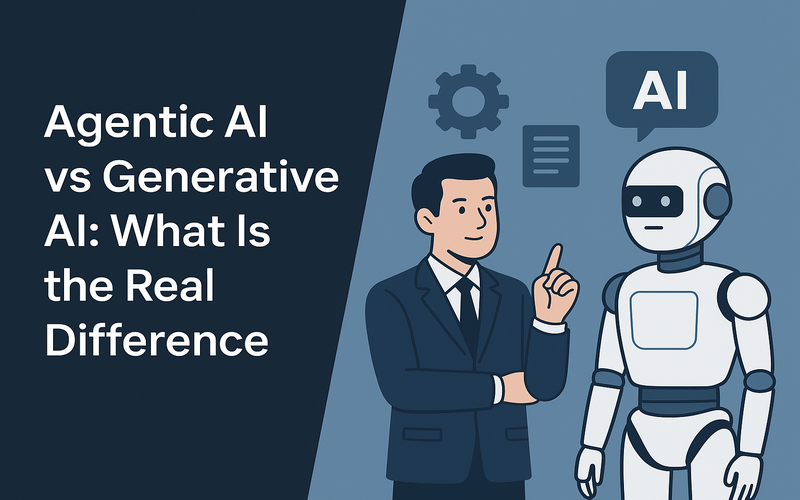
Artificial intelligence is evolving rapidly, and businesses are increasingly comparing agentic AI and generative AI to understand which technology best suits their operational needs. Although both technologies fall under the AI umbrella, they serve very different purposes. Understanding the agentic AI vs generative AI difference is essential for CTOs, product leaders, and businesses investing in AI-driven transformation.
What Is Generative AI?
Generative AI focuses on creating content such as text, images, code, audio, and video using pretrained machine learning models. Tools like GPT, DALL·E, and Midjourney are common examples of generative AI systems.
These systems work by identifying patterns in massive datasets and generating outputs based on user prompts. Generative AI is highly effective for content generation, summarization, translation, brainstorming, and customer support assistance.
Businesses commonly use generative AI for:
- Content writing and blog generation
- Marketing copy creation
- Email drafting
- AI chatbots
- Code assistance
- Knowledge summarization
While generative AI improves productivity and creativity, it primarily remains reactive. It responds to prompts but does not independently plan, execute workflows, or adapt strategically over time.
What Is Agentic AI?
Agentic AI represents a more autonomous form of artificial intelligence capable of planning, reasoning, decision-making, and executing multi-step tasks with minimal human intervention.
Unlike generative AI, agentic AI systems can:
- Set objectives
- Create execution plans
- Use external tools and APIs
- Adapt based on outcomes
- Continuously optimize workflows
Agentic AI is designed for operational intelligence rather than simple content generation. It is commonly used in workflow automation, customer operations, logistics optimization, enterprise orchestration, and autonomous business systems.
For example, iTechNotion develops agentic AI systems capable of automating supply chain management, customer support workflows, and operational decision-making processes.
Agentic AI vs Generative AI: Core Differences
1. Purpose
Generative AI: Focused on generating content and responding to prompts.
Agentic AI: Focused on achieving goals through planning, reasoning, and execution.
2. Autonomy
Generative AI: Requires human prompts and supervision.
Agentic AI: Operates autonomously and adapts based on changing conditions.
3. Workflow Management
Generative AI: Handles single-response interactions.
Agentic AI: Manages multi-step workflows and decision-making processes.
4. Tool Usage
Generative AI: Usually limited to generating outputs.
Agentic AI: Can interact with APIs, databases, CRMs, and enterprise systems.
5. Adaptability
Generative AI: Reactive and prompt-based.
Agentic AI: Dynamic and capable of adjusting strategies during execution.
Where Generative AI Performs Best
Generative AI is highly effective in areas where rapid content creation and language understanding are required. Organizations use it to improve productivity, accelerate communication, and automate repetitive creative tasks.
Popular generative AI applications include:
- Blog and article generation
- Marketing campaigns
- AI-powered search assistants
- Internal documentation
- Code suggestions
- Language translation
For businesses looking to improve efficiency without implementing fully autonomous systems, generative AI often provides a faster and lower-cost starting point.
Where Agentic AI Delivers Greater Value
Agentic AI becomes significantly more valuable when workflows require autonomy, coordination, and long-term execution.
Examples include:
- Autonomous customer support systems
- AI workflow orchestration
- Supply chain automation
- Financial process automation
- Intelligent enterprise operations
- Autonomous AI agents
AI workflow automation services powered by agentic AI can continuously monitor operations, make decisions, execute tasks, and optimize performance without requiring constant human input.
Challenges of Generative AI
Despite its popularity, generative AI has several limitations:
- Limited reasoning capabilities
- Lack of long-term planning
- Hallucinated or inaccurate outputs
- No autonomous execution
- Limited real-world adaptability
Human review is often necessary when using generative AI in high-risk or business-critical environments.
Challenges of Agentic AI
Agentic AI systems are more advanced but also more complex to implement and manage.
Common challenges include:
- Higher implementation complexity
- Infrastructure and integration requirements
- Security and governance concerns
- Greater operational oversight needs
- Increased development costs
However, the long-term operational benefits can be substantial for enterprises seeking intelligent automation at scale.
How Businesses Should Choose Between Agentic AI and Generative AI
Businesses should evaluate several factors before choosing an AI approach:
- Workflow complexity
- Need for autonomy
- Operational scalability
- Budget and implementation timeline
- Security and compliance requirements
Organizations focused on productivity and content automation may benefit more from generative AI initially. Businesses requiring advanced workflow orchestration and intelligent automation should consider agentic AI solutions.
Many enterprises now combine both technologies into hybrid AI systems, using generative AI for content tasks and agentic AI for orchestration and execution.
How iTechNotion Builds AI Solutions
iTechNotion develops both generative AI and agentic AI systems tailored to business objectives, operational requirements, and scalability goals.
The company helps organizations:
- Build AI-powered workflow automation systems
- Develop autonomous AI agents
- Implement enterprise AI integrations
- Create generative AI applications
- Design scalable AI architectures
By aligning AI implementation with business strategy, iTechNotion helps companies adopt practical, scalable, and high-performing AI solutions.
Final Thoughts
The difference between agentic AI and generative AI goes beyond terminology. Generative AI excels at creativity, language generation, and productivity enhancement, while agentic AI focuses on autonomy, planning, and intelligent execution.
As AI adoption continues to grow, businesses must understand these differences to make informed technology investments and build future-ready operations.
Looking to implement AI solutions for your business? Contact iTechNotion to explore scalable generative AI and agentic AI solutions tailored to your organization.