Why traditional RPA is not enough anymore — the intelligence gap
Robotic Process Automation has been great for repetitive tasks, but as soon as you need judgment or adaptability, it hits a wall. It works wonders for consistent, structured tasks like copying data from one place to another. But what about when things get a bit messy? When processes involve unstructured data or need decisions made on the fly, that's where RPA struggles.
Traditional RPA bots are like the hard workers who follow rules to the letter. But give them something unexpected, and they’re lost. This is why businesses often find themselves constantly tweaking RPA settings or falling back on manual steps when something changes or goes wrong.
Enter AI agents: They don’t just follow rules; they adapt, learn, and make reasoned decisions, closing the gap and making automation smarter and applicable to more complex workflows.
What AI agents add to business process automation — reasoning, decision-making, adaptability
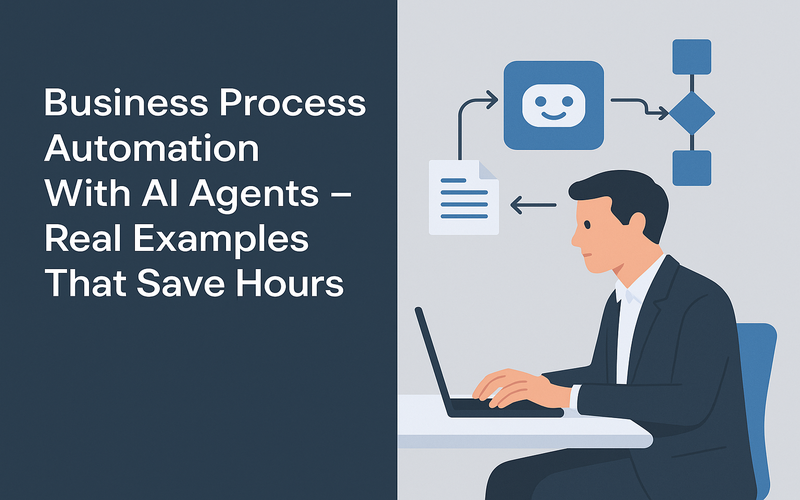
AI agents are like the next-gen bots, powered by smart tech like machine learning and natural language processing. Unlike RPA, they can read data and adapt to what they find.
AI agents bring:
- Reasoning: They get the context and figure things out, not just follow scripts.
- Decision-making: They make choices based on loads of data and trends, like who should handle a support ticket or how to prioritize sales leads.
- Adaptability: They keep up with changes in data and scenarios without needing constant reprogramming.
This makes AI agent automation a lot more flexible, letting tech handle tasks once thought too complex, saving time, cutting mistakes, and boosting productivity.
And it’s catching on; reports like Forrester's 2021 RPA study show intelligent automation growing fast, with big market gains expected by 2026.
Example 1 — Sales pipeline automation: lead scoring, enrichment, follow-up sequences
Sales folks usually have to manually score leads and make calls, which is tedious. AI can turbocharge this with:
- Lead scoring: AI looks at tons of data points like company size or online activity to give a nuanced score.
- Lead enrichment: It fills in missing contact details automatically from trusted sources.
- Follow-up sequences: AI can time personalized emails or reminders based on interaction clues.
Real-world scenario: iTechNotion helped a SaaS firm automate their lead process, using AI to score and enrich leads, and providing sales teams with follow-up blueprints, saving 15 hours weekly and boosting lead conversion by 25%.
Example 2 — Invoice processing: extraction, validation, approval routing, payment
Manually handling invoices can be a pain—different formats, approval steps. AI agents automate it:
- Data extraction: They use computer vision to read invoice details regardless of the layout.
- Validation: The AI checks data against purchase orders to spot errors.
- Approval routing: AI decides who needs to approve it, sending out instant notifications.
- Payment initiation: After approval, AI manages payments and logs everything for audits.
This kind of automation zaps errors and speeds up payments.
iTechNotion case study: They helped a logistics client automate invoices, cutting down processing time from days to hours and slashing payment errors by 40%.
Example 3 — HR onboarding: document collection, account setup, orientation scheduling
Onboarding is a juggling act—documents, accounts, meetings. AI agents streamline it:
- Document collection: AI prompts for documents, checks them, and keeps tabs on what's done.
- Account setup: It automates account creation for new hires, according to their roles.
- Orientation scheduling: AI plans and sets up training sessions, working around schedules.
Quick onboarding improves compliance and satisfaction.
Practical example: For a health startup, iTechNotion’s AI shave 60% off HR's onboarding time, engaging new hires better.
Example 4 — Customer support: ticket classification, resolution, escalation
Support teams battle a barrage of tickets. AI agents ease the load:
- Ticket classification: AI sorts and prioritizes tickets based on content and urgency.
- Automated resolution: AI responds to common questions using internal data or chatbots.
- Escalation: Tough or urgent cases go to humans, with handy tips attached.
This speeds up responses and lightens support team workloads.
iTechNotion impact: For a SaaS company, their AI triaged 75% of tickets, handling 40% with chatbots, cutting resolution times by a third.
Example 5 — Reporting: data collection, analysis, distribution on schedule
Creating reports involves pulling together data, analyzing it, and sharing insights. AI agents do it all:
- Data collection: They extract info from various systems at set times automatically.
- Analysis: AI applies statistical models to highlight trends or risks.
- Distribution: They send out formatted reports to stakeholders like clockwork.
This trims down manual report prep and ensures timely insights.
Case in point: iTechNotion helped a retail chain automate sales reports, saving the analytics team over 10 hours weekly.
How to identify which processes are ready for AI agent automation
Not all processes should be handed over to AI. You’ll want to pick ones like:
- Repetitive tasks with consistent input: Tasks with regular, high-volume cycles.
- Decision points requiring judgment: Where choices depend on multiple data inputs.
- High error or delay rates: Tasks plagued by manual mistakes or slowdowns.
- Data availability: There’s plenty of data for AI to chew on and learn from.
- Impact potential: If automation would save loads of time or cash.
With these lined up, AI agents can take mundane workflows and make them snappy without the usual manual hassle.
What iTechNotion has built for clients across these categories
iTechNotion's got tons of experience tailoring AI automation to fit different industries and workflows. They work with clients to pinpoint issues and create AI-driven setups that mesh seamlessly with current systems.
Highlights include:
- AI sales solutions that enrich lead engagement and improve sales conversions.
- Invoice processing with smart data extraction and validation, nipping human errors.
- Slick HR onboarding, streamlining document handling and boosting employee satisfaction.
- Support solutions that automatically sort tickets and bolster response speeds.
- Reporting tools that gather and analyze data, offering actionable insights without the hassle.
iTechNotion's projects are all about delivering reliable, scalable AI automation that enhances digital operations without skipping a beat.
They also advocate for ongoing monitoring, keeping human oversight in place, and fine-tuning models to avoid bias and glitches.
AI agents, while not a magic fix-all, are an investment in the future of efficient business processes, cutting both time and headaches for competitive edge.
Conclusion
Automating business processes with AI agents is changing how companies tackle complex workflows. From sales to invoicing, HR, support, and reporting, AI automation creates adaptable processes that trim hours and limit errors.
Unlike traditional RPA, AI agents adapt and decide in real-time, unlocking automation potential for intricate tasks.
For business leaders or new founders exploring AI avenues, it’s crucial to identify where AI can make a difference—starting with repetitive, decision-focused tasks.
Teaming up with seasoned pros like iTechNotion ensures you’re using tried-and-tested methods, credible data, and smart insights to set up scalable AI automations that navigate limitations soundly.
Keen to save hours and revamp your workflows? Reach out to iTechNotion to see how AI agent automation fits with your business goals.