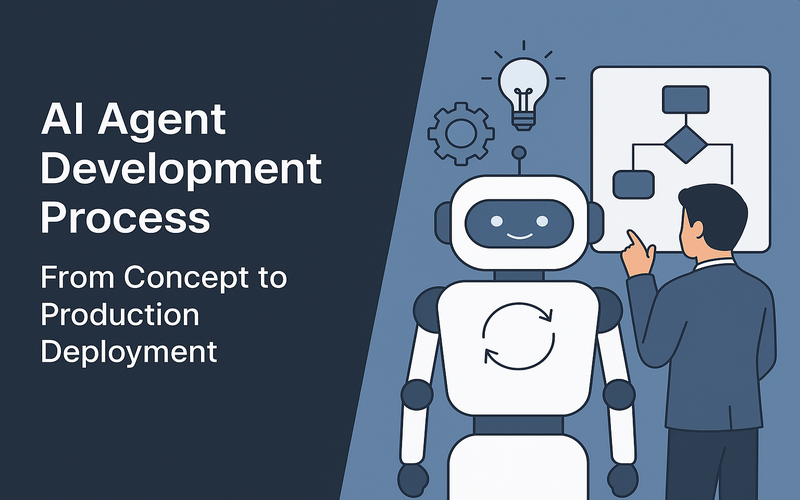
Planning and fine-tuning an AI agent is now more crucial than ever for businesses eager to automate, make informed decisions, and amp up their AI-driven operations. But a lot of projects don't even make it past the starting line because they skip important steps or start without a clear plan. We're here to change that by walking you through each key phase, pointing out the traps you might stumble into, and showcasing how pros like iTechNotion ensure each step delivers real payoffs.
Why most AI agent projects fail — skipping the design phase
The design phase is the foundation, and skipping it can lead to disaster. When projects dive in without a solid understanding of the agent's goals, limits, and decision thresholds, they can quickly derail. Effective design demands collaboration among product managers, AI engineers, and stakeholders, setting up clear goals and boundaries.
For instance, when we worked on a logistics AI agent to improve route choices, we didn't rush. We took the time for an in-depth discovery to nail down specific performance metrics and fallback scenarios. Missing this crucial stage would have meant big delays, as initial guesses were often way off.
Phase 1 — Discovery: defining the agent's goal, scope, and decision boundaries
Clarifying the agent’s purpose
In discovery, product managers and operations leads focus on the problem at hand, ensuring the AI agent's goals are crystal clear. It's all about the workflows it has to mesh with and the results it’s meant to bring.
Defining scope and constraints
This part's about nailing down what the agent deals with — inputs, environment, and outputs — and setting clear boundaries for when humans step in. What's reliable? What's the last straw before it hands over to a person?
Use case validation with stakeholders
Feedback? It's key here. Involving users and stakeholders from the start validates problems and helps define what success looks like. Plus, it sets the stage for future tweaks.
Phase 2 — Architecture design: tools, memory, reasoning model, human handoff points
Choosing the right tools and frameworks
Selecting tools isn't random; it’s got to fit the agent's job. At iTechNotion, using frameworks like OpenAI’s APIs plus custom layers for task handling is our norm, with memory aids like databases to keep track of contexts.
Designing the reasoning and response model
We lay out how the agent thinks and adapts — ensuring it deals smartly with murky data and has backup processes if things go south.
Deciding on human handoff and fail-safe points
Setting up triggers for when a human needs to jump in is vital for reliability. Whether it's odd inputs or low confidence scores — knowing when to tap out to a human keeps things secure.
Phase 3 — Development: building the agent loop, tool integrations, and error handling
Constructing the agent’s core loop
During development, the focus is on crafting the agent's heart: taking inputs, making decisions, executing actions, and updating its state. That continuous loop is the bedrock of interactions and response quality.
Integrating external tools and APIs
AI agents don't usually work in a vacuum. Tying them into systems like CRM or other APIs requires rock-solid connections and testing for any hiccups.
Building robust error handling and recovery
Preparing for the unexpected is non-negotiable. iTechNotion ensures processes handle errors gracefully with a design that prevents total system meltdowns, supported by systematic logging for troubleshooting.
Phase 4 — Testing: simulated runs, edge case handling, failure mode testing
Simulating real-world scenarios
Testing mimics what the agent will face, allowing it to strut its stuff under normal workloads and hints at any early slowdowns.
Addressing edge cases and anomalies
The weird and rare cases can trip you up, so the team creates scenarios that cover all the unusual angles, like unexpected input patterns.
Failure mode and stress testing
Being ready for total strain tests, which push the system's endurance and reactions during tough times, is pivotal to sustaining the agent’s reliable performance.
Phase 5 — Deployment: infrastructure, monitoring, logging, cost management
Setting up scalable infrastructure
Think cloud. AI agents need environments that grow and shrink with use, like using containers or serverless platforms to streamline costs.
Implementing comprehensive monitoring and logging
Keep tabs on the agent's health with monitoring systems that alert you to any red flags early on to address issues right away.
Managing operational costs
Eyeing costs closely is key. Fine-tuning prompts and optimizing resource use keeps the operation affordable and smooth.
Phase 6 — Iteration: performance review, prompt refinement, capability expansion
Analyzing performance metrics and user feedback
After launching, reviewing metrics such as success rates and listening to end-user feedback will pinpoint usability hitches and prompt ideas for fresh features.
Refining prompts and conversation flows
Fine-tuning prompts can bolster the agent's understanding and precision, improving its responses through smarter conversations.
Expanding capabilities based on evolving needs
When business demands shift, adding new connections, skills, or deepening reasoning empower further advancements, making the iterative process central to innovation.
Common pitfalls at each phase and how to avoid them
Discovery pitfalls
Miss early chats with stakeholders, and goals become foggy. Commit to comprehensive gathering of requirements and aligning promptly.
Architecture pitfalls
Choosing the wrong setup or sidelining human cover can hurt. Walk the line between automation and human touch thoughtfully.
Development pitfalls
Oversight in tool pairing and handling misses in errors causes havoc. Start building and testing in tandem.
Testing pitfalls
Narrow test coverage lets bugs creep out. Stress thoroughly diverse scenarios without missing the rare cases.
Deployment pitfalls
Skipping monitoring or allowing budget to fly high weakens sustainability. Make frequent checks and adjust to stay on a healthy trajectory.
Iteration pitfalls
Dismissing feedback or metrics arrests the agent's growth. Foster a culture of always getting better.
Timeline and resource expectations for a real AI agent project
Usually, an AI project can stretch over 3-6 months, based on intricacy and how many folks are on board. Take the logistics client we supported at iTechNotion: discovery and architecture were done in 6 weeks, with 8 weeks for building and testing, topping off with a 4-week deployment sprint. The team packs in product managers, AI developers, QA folks, and infra experts. Price-wise? It varies from about $150k to $500k, depending on what's in play.
How iTechNotion manages each phase for clients
iTechNotion excels with its structured step-by-step strategy for AI projects. We kick off with intensive workshops charting out goals and limits. Seasoned architects then draft agile, scalable systems. Development cycles keep things nimble with tool-integrated designs. Testing mirrors both simulated and real conditions with robust error latching. Deployment tactics center on scalable, budget-wise infrastructure with active oversight. Post-launch iteration tracks client aspirations and advances endlessly.
With the logistics case, iTechNotion tapped OpenAI APIs and memory databases for contextual prowess. Kubernetes drove container orchestration for seamless upscaling during peak times. Dashed insights highlighted value post-deployment, cutting route choices by 35%, sparking real business results.
Challenges subsist, mingling autonomy and human oversight, along with minding AI operational spendings. iTechNotion counsels candid conversations with players on limits and on-going refinement drives. Sticking to this disciplined development groundwork sets reasonable expectations and nurtures trust in AI endeavors.
Conclusion
Marching through an AI agent development project means heeding meticulous design, smart architecture, detailed development, layered testing, coordinated deployment, and constant iteration. Blitzing past steps incurs disruption. Product managers and operational leads must unionize with tech talent to spell out clear, concise goals, scope, and yardsticks. Selecting apt tools and plotting human takeover factors heavily into reliable results.
Observation from real-world projects highlight that explicit follow-through breeds definitive business returns and amplifies scalable AI processes. iTechNotion’s portfolio across diverse terrains marks a reliable code for executing AI agents from cradle to production.
Ready to launch your AI agent guided by genuine mastery? Reach out to iTechNotion now to discuss your unique requirements and embark on your AI agent creation journey with a dependable ally.