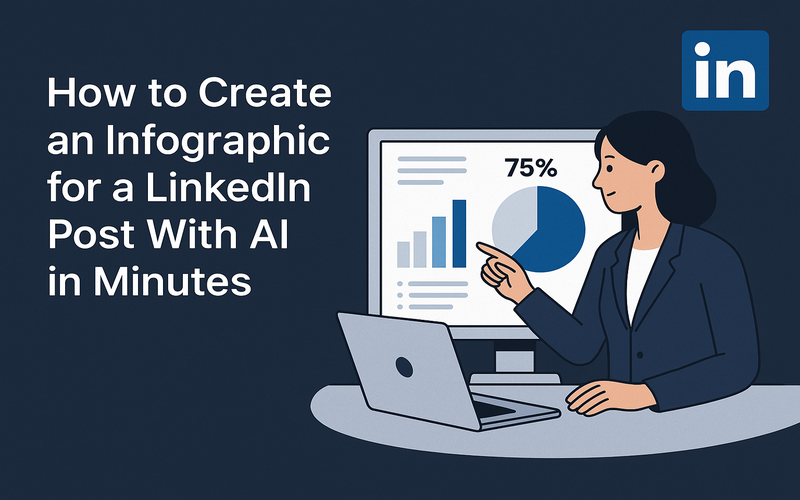
Creating infographics for LinkedIn can be a breeze, even if you're new to AI. These eye-catching visuals make it easier to engage and communicate complex ideas. LinkedIn's a professional hangout, and visuals like infographics are big hits because they simplify data that plain text might complicate.
Why infographics perform better than plain text on LinkedIn — the data
LinkedIn stats say image posts double the engagement of text-only posts. Infographics step it up a notch by combining visuals, data, and concise messaging, driving more likes, shares, and comments.
Take iTechNotion for example, they used infographics to illustrate their automation services and soon noticed a spike in profile visits and inquiries. Infographics don't just inform; they pull in business opportunities.
What sets LinkedIn infographics apart from others
Infographics for LinkedIn aren't like the ones you slap on your blog or print out. They need to fit the platform's vibe and scrolling habits. People skim quickly there, so your infographic needs:
- Compact format: Don’t overload with text; show key points at a glance.
- Readable fonts: Use clear, professional fonts right for on-screen reading.
- Mobile-friendly size: Make sure it looks good on phones, where most browsing happens.
- Brand alignment: Match your company’s colors and logos.
Essentially, these graphics need to be focused and easy on the eyes, conveyed quickly.
Key structure of a top-notch LinkedIn infographic — dimensions, hierarchy, CTA
Optimal dimensions
LinkedIn advises 1200x627 pixels for images, but infographics often work best vertically, say 1080x1920 pixels. It fits well on both mobile and desktop, without cramming the feed.
Visual hierarchy
Use hierarchy to guide viewers through. Headlines and stats should be big and bold. Organize info in sections with whitespace or lines to separate. Icons help make points pop without crowding.
Include CTAs
A call-to-action rounds off your infographic by suggesting a next step, like “Visit our website,” or “Connect with us.” It should stand out, but not scream sales – LinkedIn folks prefer a gentle nudge.
How AI crafts infographics — from topic to visual design
Content understanding and creation
AI kicks off by breaking down your topic using NLP to pull out key elements and relevant data. It then crafts brief text parts, summaries, or stats to populate your infographic.
Visual design automation
AI design tools choose layouts, fonts, colors, and icons based on readability and visual appeal best practices, with LinkedIn’s preferences automatically taken care of.
Continuous learning and customization
AI systems improve over time with feedback and use data. Users can tweak styles and brand parts, which the AI keeps consistent across visuals.
Tools involved — AI content generation, design automation, brand kit integration
AI content tools
Platforms like ChatGPT and Jasper AI can help write the text for your infographic—headlines, bullet points, summaries. They get the tone and audience to deliver engaging content.
Design automation tools
Tools such as Canva’s AI suggestions, Visme, or Adobe Express handle layout and graphic selection automatically. Many provide LinkedIn-optimized templates.
Brand kit integration
Maintaining brand harmony is key. Some generators let you add brand stuff like colors, logos, and fonts. iTechNotion’s service uses this to make sure branded content hits the mark without extra editing.
Step-by-step guide — from topic idea to infographic on LinkedIn
Step 1: Define your goal and audience
Determine what message and action you want from your LinkedIn viewers. Maybe you want to simplify a complicated service or share industry stats.
Step 2: Gather content and data
Compile important facts, numbers, quotes, or insights related to your topic.
Step 3: Use an AI content generator
Put your content into an AI tool to create concise text for your infographic sections.
Step 4: Choose a LinkedIn infographic maker
Select a design tool that supports LinkedIn format requirements. Add your brand kit if you have one.
Step 5: Design and customize
Use AI-generated layouts or templates, swap out icons or images, and adjust colors and fonts to your liking.
Step 6: Review and refine
Ensure clarity and visual balance, and make sure your CTA is noticeable.
Step 7: Export and publish
Download your infographic ready for LinkedIn sharing and post it with a fitting caption on your profile or company page.
Common infographic mistakes on LinkedIn and how to dodge them
Overloading with text
Skip dense text blocks; break it up into digestible pieces and use visuals for clarity.
Poor mobile readability
Test your design on phones to confirm the text and graphics are clear.
Ignoring LinkedIn sizing
If you don’t follow LinkedIn’s image sizing, it can get cropped or display poorly.
Clashing brand colors
Stick to your brand palette. Random colors confuse and seem unprofessional.
Weak or missing CTA
Wrap up your infographic with a clear, engaging action prompt.
How iTechNotion creates branded infographics with their automation service
iTechNotion utilizes AI to automate creating infographics for LinkedIn, all while making sure your brand stays consistent in color schemes, logos, and fonts.
By merging AI-generated content with design automation, they guarantee quick delivery—clients receive ready-to-go infographics in minutes instead of days. They make sure layouts emphasize important details and the CTAs are clear, ensuring visual impact and brand unity.
Clients who try iTechNotion see improved LinkedIn engagement and spend less time crafting visual content. It's proof that AI-powered infographic solutions for LinkedIn can greatly benefit busy business owners and non-techy founders.
Even though AI simplifies designing, some human insight is still essential to ensure the content aligns precisely with your business objectives. That’s where iTechNotion’s expert advice comes in handy.
Conclusion
Grasping how to create infographic for LinkedIn post with AI can help business owners and founders boost their communication and cut down on time spent. LinkedIn infographics need specific design and content tweaks to pop in a busy feed. Employing AI-driven LinkedIn infographic tools speeds up the process from concept to the final image.
Keep an eye on LinkedIn-friendly dimensions, clear visual order, brief messaging, and a significant CTA. Avoid pitfalls like clutter and hard-to-read designs. Services like iTechNotion showcase the power of blending brand consistency with AI automation.
Start checking out AI infographic tools today to amp up your LinkedIn content and make your posts more engaging. Getting the hang of this simple skill could quickly lead to a stronger online presence and better business connections.
Ready to dive into infographics? Give an AI-driven LinkedIn infographic tool a shot now or reach out to iTechNotion to see how automated branded infographics can back up your LinkedIn game.