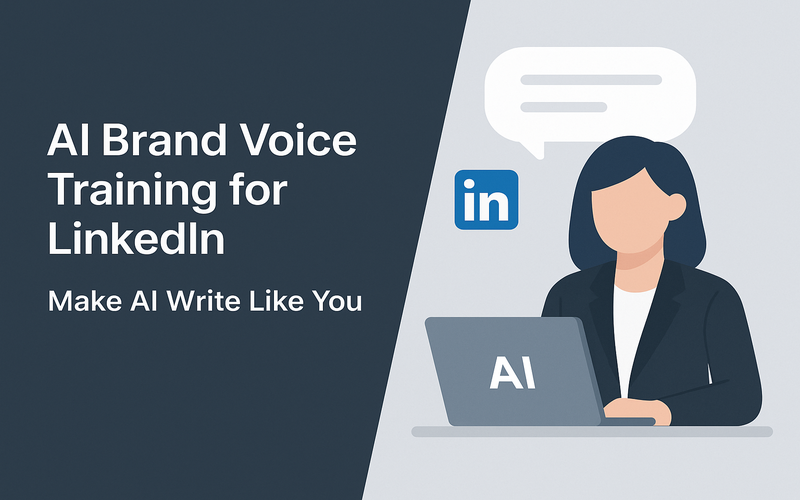
LinkedIn is a powerhouse for business owners and those who aren't tech-savvy, providing a stage to broaden their network and tell their brand's story. Yet, automating LinkedIn content with AI can be tricky, especially if the output feels like a robot lacking your voice. This piece shows how AI brand voice training can teach AI to 'write like you,' ensuring that your posts feel genuine and connect better with your audience.
1. The authenticity problem with generic AI LinkedIn content
When AI spews out LinkedIn posts without understanding your brand, the result often feels blah, boring, and disconnected. This inauthentic vibe can hurt your brand's personality and make people skeptical of what you're saying. Rather than showing off your expertise, generic content risks your voice getting lost in a sea of automated posts.
Imagine a business owner relying on a well-known content tool and receiving posts that sound robotic or too stiff. These posts usually miss key tones like humor or industry-specific jargon. Plus, your LinkedIn audience might not recognize these posts as genuinely yours or engage meaningfully with them.
This authenticity gap is a known struggle in content marketing. According to a 2024 Content Marketing Institute report, 65% of pros say authenticity in content is the top factor influencing their trust. It's clear that AI-generated content needs to match your brand's personality to keep its credibility intact.
2. What brand voice training actually means in an AI context
In the realm of AI, training a brand voice means customizing AI’s output to mimic your unique style, tone, and vocabulary. It's more than just getting the grammar right; it's about capturing your brand's essence and speaking directly to your audience.
Think of it like giving AI a persona that sounds like your team or even you personally. This ensures that your content feels consistent and helps build recognition among your LinkedIn crowd.
Brand voice training involves showing AI examples and guidelines to help it pick up on what makes your communication style unique. Are you formal or casual? Do you use industry terms or layman's language? How do you structure sentences and deliver messages? These specifics guide the AI in its output.
3. How AI learns your tone, vocabulary, and content style
The role of machine learning and NLP
AI leverages machine learning (ML) and natural language processing (NLP) to sift through massive amounts of text and spot patterns. By training AI with data from your LinkedIn activity, it learns how you typically structure sentences, which words you favor, your tone markers, and what themes you focus on.
Key elements AI detects during training
- Tone: Is your voice welcoming, authoritative, inspiring, or straightforward?
- Vocabulary: Do you lean towards technical speak, plain English, or emotive language?
- Content style: Are your sentences detailed, or short and impactful? Is the style formal, chatty, or narrative?
- Message focus: What themes and topics do you regularly discuss? What's the main takeaway you usually highlight?
By grabbing examples of your content—LinkedIn posts, blogs, style guides—the AI creates a model that predicts your preferred communication style. This means the AI writes text that feels like it’s coming from you, not a faceless machine.
4. The inputs needed — examples, style guides, content pillars
Training AI on your brand’s voice requires particular inputs:
Examples of existing content
These are essential. Your past LinkedIn posts, emails, or marketing material show your real voice and message. That's what the AI looks at to pick up on your style's subtleties.
Style guides
A well-defined style guide that outlines your brand’s tone, grammar choices, and voice traits gives clear direction to the AI. It includes do’s and don’ts, preferred words or phrases, and formatting guidelines.
Content pillars and key themes
Content pillars are the central topics or ideas at the heart of your brand messages, like innovation, customer triumphs, or leadership. Instructing AI on these pillars helps align generated content with your strategy.
A real-world example: iTechNotion’s approach
iTechNotion works with clients to gather comprehensive examples, enhance them with formal style guides, and define clear content pillars. This process gives AI well-rounded inputs during brand voice setup phases.
5. How brand voice training changes the AI output quality
Training AI with your brand voice makes a huge difference:
- Consistency: Your posts maintain a uniform tone and terminology, strengthening brand recognition.
- Authenticity: Content feels like it's crafted by you or your team, boosting trust.
- Engagement: Tailored messages connect more deeply with your audience, encouraging interaction.
- Efficiency: Saves time by reducing the need for intensive manual edits or corrections.
iTechNotion recently helped a SaaS company enhance LinkedIn engagement by 30% in just three months. The secret was capturing the founder's conversational yet professional tone with a tailored AI voice setup, which helped draw followers who appreciated the genuine vibe.
When brand voice training is absent, AI outputs can be all over the place, with off-tone content, awkward jargon, or off-topic writing, which lowers its usefulness. Investing in proper AI brand voice training is crucial.
6. Ongoing refinement — how the AI improves over time
AI brand voice training isn’t a one-and-done deal. It involves ongoing feedback and refinement to keep up with evolving brand needs and language trends.
Regular review of AI outputs
Brands should keep an eye on AI-generated LinkedIn content regularly, checking for errors, mismatched tones, or style shifts and using these insights to update training data.
Adding fresh examples
As your brand voice evolves—for example, becoming more approachable—new examples and style instructions should inform the AI models.
Leveraging human feedback
Human editors flag AI missteps and offer corrections, which feed back into the training system, refining AI accuracy over time.
iTechNotion uses proprietary tools to track output quality metrics and gather client input, ensuring ongoing model tweaks and keeping AI aligned with real-world results.
7. Brand voice validation — the human oversight layer
Human judgment remains crucial for ensuring brand voice quality. While AI can replicate style, fully understanding contexts, subtle sentiments, or emerging industry trends still needs human oversight.
Human reviewers check for:
- Alignment with brand values and ethics
- Correct use of industry-specific terms
- Relevance to current market trends and audience interest
- Emotional connection and clear messaging
This human check reduces risks of tone-deaf or inappropriate content that might damage your reputation or confuse followers. It also highlights AI’s limitations and knowledge gaps.
At iTechNotion, every AI-generated LinkedIn draft gets a once-over by content specialists before approval, ensuring it's reliable and safe for your brand. This blend of AI scalability and human expertise works wonders.
8. How iTechNotion configures AI brand voice for each client
iTechNotion uses a step-by-step process to tailor AI brand voice for LinkedIn:
Discovery and content audit
They collect and analyze your brand's existing content, social media posts, and style docs to grasp your voice and tone.
Custom dataset creation
Then, they compile and annotate text samples to showcase brand language traits for AI training.
Model training and testing
Using advanced NLP, iTechNotion builds custom AI models to generate samples, undergoing iterative testing and refinement.
Client feedback and collaboration
Clients give feedback on draft tone accuracy and message fit, which fine-tunes the AI’s capabilities.
Implementation and support
Once the AI consistently crafts top-notch brand voice content, iTechNotion integrates AI tools into clients’ LinkedIn workflows with ongoing support and quality checks.
This practical approach embodies iTechNotion’s expertise in AI-powered LinkedIn solutions, aiding business owners and non-tech founders in leveraging AI while retaining brand essence.
Conclusion
AI brand voice training for LinkedIn fills the gap between run-of-the-mill automated content and authentic, consistent messaging that truly represents your brand. Teaching AI your tone, vocabulary, and style through examples, guides, and ongoing refinement ensures your LinkedIn presence is spot on.
With iTechNotion's practical mix of AI innovation and human guidance, you can fine-tune your brand’s voice over time. This creates compelling content your audience relies on and trusts, turning AI into an asset, not a drawback, for your LinkedIn strategy.
If you're a business owner or non-tech founder keen on using AI without losing your unique voice, contact iTechNotion today. Explore how custom AI voice LinkedIn solutions can elevate your content strategy, keeping it genuine and consistent.