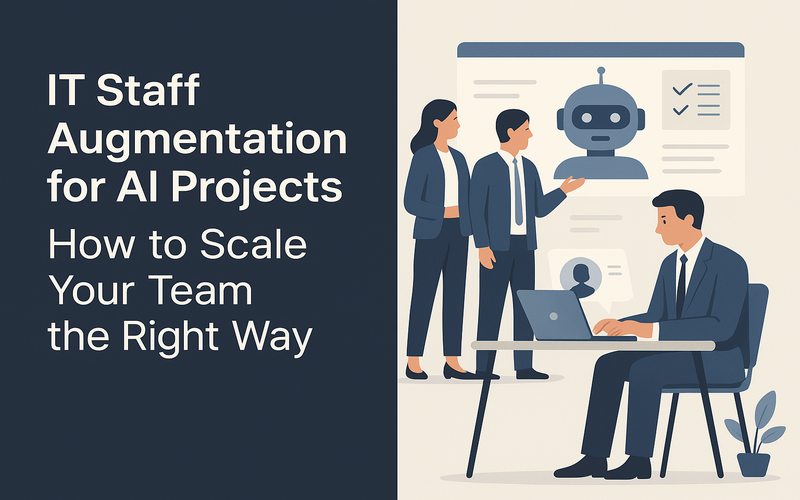
IT staff augmentation for AI projects is becoming a go-to method for scaling AI teams with the right talent quickly, minus the downsides of full outsourcing or freelance gigs. If you're a product manager or leading operations on AI systems, getting your team size just right is crucial for your project's success. This piece dives into staff augmentation basics, real-world examples, key roles, integration tips, and how costs stack up, showing how iTechNotion can help you build and launch impactful solutions in AI.
What IT staff augmentation means for AI projects — not outsourcing, not freelancing
Defining IT staff augmentation in the AI context
IT staff augmentation means bringing external AI specialists into your team to fill specific skill gaps or boost capacity for AI projects. It's different from outsourcing, where a third party takes full charge of a project. With staff augmentation, you’re still in control of management, workflows, and quality. Unlike freelancing, augmented staff are typically more deeply integrated, working like full-timers.
Why it matters for AI projects
AI work demands specialized skills, like ML engineers good at model tuning, LLM developers who know language models inside out, or AI architects crafting sturdy infrastructure. These skills are in short supply and always evolving. By augmenting your team with these experts, you quickly gain access to talent fluent in the latest AI tools and frameworks, skipping long hiring processes and the expense of full-time hiring. Augmentation allows effective scaling while you maintain control.
Example from iTechNotion
Take how iTechNotion helped a fintech client launch a smart risk assessment system. They needed more muscle in AI swiftly but didn’t want to hand over control to an outside firm. We stepped in with tailored staff augmentation, letting our engineers join their team directly, providing expertise in model development and deployment. The client met their tight launch deadline, keeping quality high and overhead low.
When staff augmentation is the right model — and when it is not
Ideal scenarios for staff augmentation
- Need for specialized AI skills: When you’re looking for niche experts in areas like NLP or computer vision temporarily.
- Flexible scalability: When your project needs are fluctuating.
- Maintain project control: When you need to keep management and intellectual property within your walls.
- Speed of hiring: When recruitment delays are not an option.
When staff augmentation is less suitable
- Lack of internal management: If your team can't give clear direction or manage additional staff, consider outsourcing.
- Entire product outsourcing: If you need full control from concept to completion, outsourcing firms with full-stack teams could be better.
- Long-term hiring needs: If permanent roles are necessary, direct hiring is better for culture fit and retention.
The roles available for AI project augmentation — ML engineers, LLM developers, AI architects
Machine Learning (ML) engineers
ML engineers are central to augmenting AI teams. They handle the design, building, and deployment of machine learning models to fit your use case. They're skilled in data preprocessing, feature engineering, model training, and optimizing performance. In augmentation for AI, they bring programming skills in Python, TensorFlow, PyTorch, and familiarity with cloud AI platforms like AWS SageMaker or Azure ML.
Large Language Model (LLM) developers
LLM developers focus on transformer-based architectures like GPT and BERT, or custom language models. They fine-tune and integrate models for various tasks, from chatbots to document summarization. With LLMs becoming more prevalent, hiring AI engineers through staff augmentation ensures you gain skills in prompt engineering, custom training methods, and ethical deployment practices.
AI architects
AI architects map out the strategy and infrastructure for AI ventures. They pick the right technologies, ensure scalability, security, and maintain AI workflows. Working alongside data engineers, ML engineers, and product teams, they make sure AI systems align with business goals. Bringing on AI architects through augmentation helps future-proof your systems.
How to integrate augmented staff with your existing team
Establish clear communication channels
For augmented staff to mesh well, set up solid communication lines. Use tools like Slack, Teams, or Jira, and have regular stand-ups to keep everyone in the loop.
Align tools and workflows
Ensure that augmented staff work in the same environment as your internal team. Consistency in tools prevents friction and fosters collaboration.
Define roles and responsibilities
Clearly define what each team member is responsible for and how they mesh with existing teams. This avoids overlap and allows everyone to focus.
Foster team culture and inclusion
Make augmented AI staff feel they belong—include them in meetings, acknowledge their achievements, and encourage open feedback. A good culture boosts productivity and retention.
Onboarding and knowledge transfer — getting augmented staff productive fast
Prepare comprehensive documentation
Before new staff come on board, pull together architecture diagrams, API specs, coding guidelines, and highlight current challenges. This prep work speeds up their adaptation.
Structured onboarding plan
Create a step-by-step onboarding plan that includes meet-and-greet sessions, access provisions, a rundown of project goals, and gradually challenging tasks.
Pair augmented staff with internal mentors
Assign internal mentors to guide them, providing answers and context on the project.
Knowledge sharing sessions
Set up regular check-ins, code reviews, and Q&A sessions to share insights and set expectations.
Managing quality and deliverables with an augmented AI team
Set clear performance metrics
Establish measurable goals such as model accuracy, deployment time, or code quality. Use continuous integration (CI) tools to track progress.
Implement code review practices
Code reviews help maintain consistency and identify issues early. Include augmented engineers in peer reviews and sustain a shared code standard.
Frequent status updates
Maintain steady communication with regular reports to spot issues early.
Use project management tools
Tools like Jira or Trello help track progress and ensure accountability.
Cost comparison — staff augmentation vs building in-house vs full outsourcing
Building in-house
Hiring AI professionals full-time demands significant spending on recruiting, training, and ongoing salaries. It encourages long-term retention and a cultural fit but can delay project timelines.
Staff augmentation
Augmenting staff allows quick access to seasoned AI engineers, often on hourly or fixed contracts, skipping costs of benefits. It provides a nice balance of control and flexibility.
Full outsourcing
Outsourcing hands full project responsibility to vendors, which might relieve management burdens but forfeits the control you have over the skills and direction of the project. Quality can vary.
Real-world cost insight
Studies show staff augmentation cuts hiring time by up to half and reduces project delays. Clients often observe 30-40% cost savings on AI staffing over building equivalent in-house teams, with more project oversight than outsourcing.
What to prepare before engaging a staff augmentation partner
Define project scope and goals
Setting clear scope and milestones ensures augmented staff contribute significantly, especially to tasks needing external expertise.
Identify skill gaps
Evaluate your current team's strengths and specify the roles needed for augmentation – be it ML engineers, LLM developers, or AI architects.
Secure technical and managerial support
Appoint internal staff who will onboard, supervise, and integrate the augmented team.
Set expectations on communication and workflows
Agree upfront on communication tools, reporting rhythms, and documentation standards with your partner.
How iTechNotion provides AI-specialist staff augmentation for client projects
Specialized AI talent pool
iTechNotion offers a select network of AI talent, skilled in advanced ML frameworks, LLM development, and AI systems design.
Flexible engagement models
Some clients might need a few ML experts, others an entire AI architecture squad—either way, iTechNotion adjusts to project scale and timelines.
Deep integration support
We ensure smooth onboarding, continuous mentoring, and full involvement in your workflows to meet project goals.
Proven track record
Our collaborations in finance, healthcare, and retail highlight significant improvements in AI development speed and quality through staff augmentation.
iTechNotion champions transparency about AI technology limits and evolving practices. We're not promising magic fixes but focusing on realistic, sustainable scaling of your AI workforce.
Conclusion
IT staff augmentation is a smart way to quickly scale your AI team with the right skills while staying in control. It fills expertise gaps, speeds up delivery, and costs less compared to direct hiring or full outsourcing. Success comes from clear goal setting, aligning workflows, and ensuring integrated team dynamics.
Working with seasoned partners like iTechNotion gives you access to carefully vetted AI experts suited to your business needs. We assist with onboarding, quality management, and knowledge sharing to help you effectively scale AI projects and achieve impactful results.
Ready to enhance your AI team with skilled IT staff augmentation? Get in touch with iTechNotion today to discuss your project and build your AI edge.