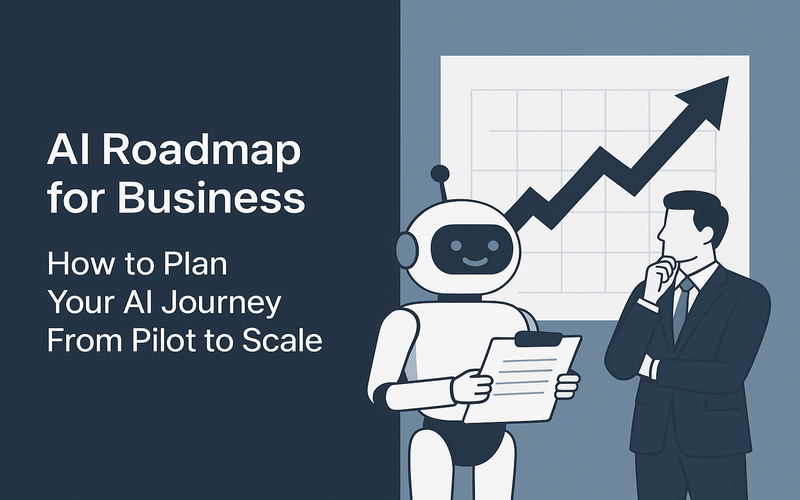
Artificial intelligence (AI) is transforming industries, offering businesses chances to better their operations, innovate products, and enhance customer experiences. But, jumping into AI without a clear plan can be a headache for many organizations. An AI roadmap for business provides a structured approach to kickstarting and scaling AI projects, maximizing return on investment (ROI) and minimizing wasted time and resources.
Why businesses need a roadmap before they start building — the cost of randomness
Diving into AI projects without a plan often results in scattered, chaotic efforts that waste time and money. Without a clear plan, teams dabble with various AI tools or use cases that don't really make a difference. Gartner reports that over 85% of AI projects fall short of expectations, mainly due to the lack of strategic planning and alignment.1
Think of a mid-size retail company that rolled out separate AI pilots for marketing, supply chain, and customer service teams. Lacking a unified plan, these projects doubled efforts, missed data quality challenges, and failed to integrate into their core operations. Six months in, costs soared, and results were fuzzy. This example shows why starting with a business AI roadmap saves resources and aligns AI initiatives with company goals.
At iTechNotion, we helped a manufacturing client steer clear of these mistakes by creating a solid AI transformation roadmap. It curbed scattered pilots and allowed for prioritized, scalable AI investments, showing measurable ROI in the first year.
The 5-stage AI adoption framework — awareness, pilot, deploy, scale, optimise
An effective AI adoption plan guides organizations through five stages to manage complexity and risk:
- Awareness: Assess readiness and understand AI’s strategic value.
- Pilot: Run focused experiments to validate AI use cases.
- Deploy: Integrate successful pilots into production environments.
- Scale: Expand AI solutions across business units.
- Optimise: Continuously improve AI models and adoption.
This methodical approach aligns investments with learning, reduces risks, and builds confidence in the organization. It's the backbone of any AI implementation roadmap that actually works.
Stage 1 — Assessing AI readiness: data, infrastructure, talent, culture
Data readiness
Data is crucial for AI. Check if your data is enough, clean, accessible, and well-managed to support AI projects. Companies often underestimate data challenges. According to a McKinsey report, over 60% of AI failures are due to poor data quality or access issues.2
Infrastructure
Examine your technology setup for scalability, security, and integration capabilities. Cloud platforms and AI toolsets reduce barriers but require a clear architecture plan.
Talent
Evaluate the AI expertise you have, or can acquire through partners. AI needs diverse skills: data science, engineering, domain knowledge, and change management. Address talent gaps early on.
Culture
Gauge your organization's readiness for digital transformation. Leadership support, collaboration, and transparent communication are key to successful AI adoption.
Stage 2 — Identifying and prioritising AI use cases
Identify AI use cases that offer real business value to keep your AI efforts targeted. Follow a structured process:
- Map out business processes and challenges.
- Evaluate AI potential: automation, prediction, personalization.
- Estimate impact on revenue, costs, and customer satisfaction.
- Assess data availability and technical feasibility.
- Prioritize use cases balancing value and complexity.
iTechNotion worked with a logistics firm to prioritize AI use cases, starting with demand forecasting that cut inventory costs by 15% in just six months.
Stage 3 — Running a structured pilot with clear success criteria
Pilots are essential to prove AI concepts before scaling, by testing hypotheses with real data in controlled environments. Key practices include:
- Setting measurable success metrics tied to business KPIs.
- Ensuring access to quality data and computational resources.
- Involving business stakeholders for buy-in.
- Managing risks related to data privacy and ethics.
- Monitoring performance and gathering feedback.
Successful pilots mitigate risk and prepare teams for deployment. At iTechNotion, we emphasize well-defined pilots to show real benefits and confirm assumptions.
Stage 4 — Production deployment and change management
Transitioning from pilot to production requires strong deployment practices. AI solutions must integrate with existing systems, maintain data pipelines, and enable monitoring for reliability.
Change management
AI adoption shifts workflows and roles. It’s vital to communicate benefits, train staff, and tackle resistance. Leadership must foster a culture open to iterative learning and ongoing feedback.
Stage 5 — Scaling and continuous improvement
Scaling AI extends successful solutions across more functions or regions. It demands scalable infrastructure, ongoing model retraining, and adjustable governance.
Continuous improvement relies on monitoring model performance, user uptake, and business impact. Tools like MLOps bring automation and transparency to AI lifecycle management.
The governance layer — keeping AI aligned with business and regulatory requirements
Governance ensures AI use complies with laws, ethics, and business policies. It includes:
- Risk assessment and mitigation procedures.
- Data privacy and security compliance.
- Transparent AI decision-making and explainability.
- Audit trails and documentation.
Given emerging legal frameworks, governance must stay updated and flexible. A governance framework builds trust with stakeholders and prevents misuse.
What a realistic 12-month AI roadmap looks like for a mid-size business
An effective 12-month AI roadmap balances quick wins with foundational work:
- Months 1-3: Assess readiness and identify prioritized use cases.
- Months 4-6: Run pilots with defined success criteria.
- Months 7-9: Deploy initial AI solutions into production, start change management.
- Months 10-12: Scale successful AI applications; establish continuous improvement and governance frameworks.
This timeline allows for measurable progress while managing risks. iTechNotion’s approach tailors this framework to your industry and business strategy.
How iTechNotion builds and executes AI roadmaps for clients
At iTechNotion, we take a holistic, business-case-driven approach to AI roadmap creation.
- Discovery: Understand strategic objectives and assess AI readiness.
- Use case prioritization: Identify AI opportunities aligned with ROI.
- Pilot management: Design, execute, and validate pilots with clear KPIs.
- Deployment: Integrate AI solutions with existing systems using robust MLOps.
- Scaling and governance: Support clients with expansion plans, governance frameworks, and continuous optimisation.
Our experience spans industries including manufacturing, logistics, retail, and finance, delivering tangible business outcomes while managing risks and regulatory compliance.
As AI technologies evolve, our roadmaps adapt to innovations such as new algorithms, data privacy laws, and user expectations.
Conclusion
Creating a structured AI roadmap for business is essential to avoid costly missteps and realize the full potential of AI. By following the five-stage framework—awareness, pilot, deploy, scale, and optimise—you can build capabilities gradually and secure business value at each step.
Assess readiness thoroughly, prioritize use cases with ROI in mind, run disciplined pilots, manage change effectively, and scale using solid governance practices. The 12-month roadmap structure balances progress with risk mitigation, fitting the pace of most mid-size organizations.
Ready to plan your AI journey with confidence? Contact iTechNotion today to craft your tailored AI roadmap and start driving measurable ROI with AI.