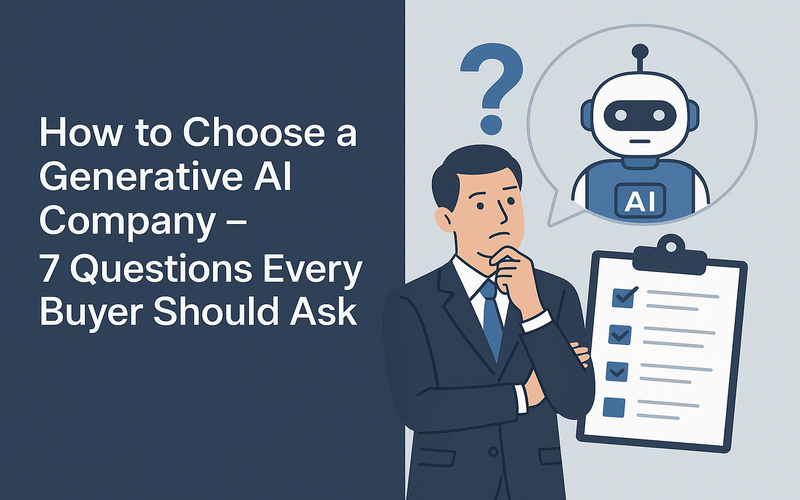
Choosing the right generative AI company is key for businesses diving into AI. This decision affects how quickly you innovate, the quality of your AI outputs, and your overall return on investment. Pick wrong, and you might find your project stuck in limbo for over a year, wasting time, money, and competitive edge. Here, we take you through seven essential questions any decision maker should consider when sizing up generative AI vendors.
1. Why Picking the Wrong Generative AI Partner Could Set You Back 18 Months
Working with an ill-fitting AI development company can lead to delays and unmet expectations. Take, for instance, a client who spent six months with a vendor that mostly sold cookie-cutter AI tools. The outcome? A dud solution. They had to restart with a new partner, costing them 18 months just to get a functioning AI system.
This kind of delay happens because generative AI projects require deep know-how, the ability to tailor solutions, and a solid grasp of data privacy and security needs. Without these, you’re either left with a solution that doesn't fit or one that fails the compliance checks, leading to expensive delays.
Gartner says 85% of AI projects stall due to misaligned vendors or unrealistic expectations. Successful projects need vendors with solid AI deployment experience that’s closely tailored to your specific needs.
2. Question 1 — Do They Create Custom Solutions or Just Resell AI Tools?
Understanding a company's product approach is crucial when choosing a generative AI company. Do they craft custom AI models suited to your specific needs, or are they just reselling third-party AI tools with small tweaks?
Custom Solutions: Companies that build AI models from scratch or adjust open-source and platform models for your specific data and goals show true development expertise. This method enables smoother integration with your systems and aligns better with your business logic.
Reselling Tools: Some companies appear as AI consultants but mainly sell APIs or prebuilt models from providers like OpenAI or Google with minimal changes. Sure, they’re quick to deploy but often lack the finesse needed for specific requirements.
iTechNotion has extensive experience in creating tailored generative AI models in industries like healthcare and manufacturing. Their personalized method tackles unique data structures and regulatory hurdles, offering more value than standard options.
3. Question 2 — Can They Show Production Deployments, Not Just Demos?
Tons of AI vendors have impressive demos, but struggle to deliver solutions that perform well at scale in real-world settings. Look for references or case studies highlighting actual deployments of their generative AI solutions.
Why It Matters: Real deployment covers managing data pipelines, monitoring models, latency issues, and software integration—stuff you won’t see in a simple demo.
Request vendors share success stories that provide tangible outcomes. For instance, iTechNotion recently launched a generative AI solution for commodity trading firms, slicing report generation time by a cool 70%, while ensuring strict auditability—proof of their delivery chops.
4. Question 3 — How Do They Tackle Data Privacy and Security?
Data privacy and security are top priorities, from industry secrets to regulated data. Generative AI firms need clear-cut policies and tech safeguards.
Checkpoints include:
- Do they follow regulations like GDPR, HIPAA, or CCPA relevant to your industry?
- What are their encryption standards for data at rest and in transit?
- How do they manage access controls and audit trails?
- How they treat client data during training—whether it stays internal or gets shared.
iTechNotion maintains strict privacy measures and provides on-premise or private cloud deployments to make sure client data stays in-house.
5. Question 4 — Do They Get Your Industry and Its Unique Constraints?
Generative AI isn't one-size-fits-all. Each sector has its own data formats, compliance demands, processes, and expectations.
Choosing an AI partner who knows your field speeds up development and enhances solution relevance. For instance, finance or healthcare regulations demand different transparency and error handling compared to retail or manufacturing.
iTechNotion’s work spans finance, pharma, and industrial sectors. Their cross-industry expertise helps them anticipate hurdles and craft fitting AI solutions.
6. Question 5 — What’s the Deal with Their Post-Delivery Support?
Launching your AI solution is just the start. Continuous monitoring, performance tweaks, and user training are key for ongoing value.
Find out about ongoing support offerings. Do they offer SLAs, bug fixes, model retraining, or helpdesk services? How fast do they tackle issues?
iTechNotion clients get packages covering model updates, performance reviews, and dedicated support, ensuring smooth operation and enhancement over time.
7. Question 6 — How Do They Manage Model Updates and Changes?
AI tech evolves fast. Models might need updates in months due to new research, data changes, or shifting business needs.
Ask about their update plans. Do they have processes for retraining or fine-tuning models? Do updates mean downtime or disruptions? How do they communicate changes?
iTechNotion uses continuous integration for AI models, reducing downtime and leveraging automated testing for reliable updates, lowering risks of performance dips.
8. Question 7 — What’s Their Honest Take on AI’s Limits for Your Use Case?
Honest vendors speak clearly about AI limitations. Sometimes, generative AI might not hit your goals or could need complementary solutions.
Beware of companies promising a flawless AI experience without addressing challenges like bias or interpretability issues.
iTechNotion offers straight-up assessments upfront, aiding clients in weighing benefits and setting realistic expectations.
9. Red Flags to Watch for in the Evaluation Process
- Shady on transparency: Vendors reluctant to share project histories, references, or deployment samples.
- No customization options: Offering only generic AI APIs.
- Vague on data security: Steer clear of firms with unclear privacy policies.
- Overpromising results: Claims that seem too good are usually just that.
- Barebones after-launch support: Offering little in terms of ongoing maintenance or update plans.
10. How iTechNotion Ticks All the Boxes
iTechNotion shines by building tailored generative AI solutions proven across industries. Their transparent data privacy approach follows strict regulations, with continuous support and model updates. Clients appreciate their candid AI limitation assessments. This mix positions iTechNotion as a solid choice for businesses needing reliable, strategic AI development that aligns with ROI goals.
Using these seven questions helps decision makers navigate the complex AI vendor landscape and avoid costly mistakes. Our experience shows how crucial this vetting process is to avoid an 18-month delay from poor vendor choices. Putting in the effort now saves you massive headaches later.
Conclusion
Picking a generative AI company requires digging deeper than just evaluating capabilities. You need to know about customization, production experience, data security, industry knowledge, support, update strategies, and AI limitations communication. Following this guide ensures selecting a partner who can deliver value promptly while effectively managing risks.
Ready to kick off your AI journey with confidence? Contact iTechNotion today to discuss your unique needs and see how our proven expertise can turn your generative AI vision into reality.