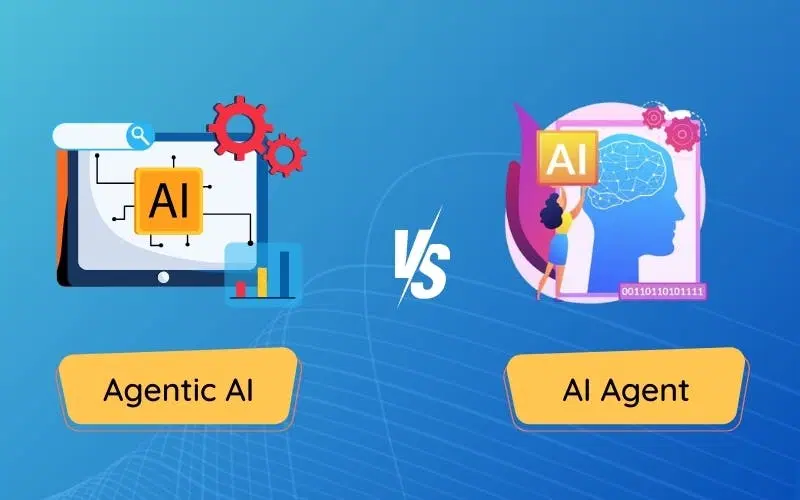
Introduction Artificial Intelligence (AI) is revolutionizing industries, from customer service to autonomous systems. However, two terms often cause confusion: Agentic AI and AI Agent. While they sound similar, they serve different purposes and operate with distinct levels of autonomy.
This blog will explain their differences, provide real-world examples, and help businesses choose the right AI technology for their needs.
What is an AI Agent?
An AI Agent is a software program designed to perform specific tasks autonomously or semi-autonomously. These agents operate within predefined rules and models to enhance efficiency and assist humans in decision-making.
Characteristics of AI Agents:
- ✔ Task-Specific – Designed for particular functions like chatbots, recommendation engines, or virtual assistants.
- ✔ Limited Autonomy – Operates within a defined scope and requires human intervention for complex decisions.
- ✔ Rule-Based or Machine Learning-Driven – Uses predefined rules or AI models to perform actions.
- ✔ Data-Driven Decision-Making – Utilizes historical data to optimize outputs.
Examples of AI Agents:
- Chatbots (e.g., ChatGPT, Dialogflow) – Automates customer interactions.
- Recommendation Engines (e.g., Netflix, Amazon AI) – Suggests personalized content.
- Virtual Assistants (e.g., Siri, Alexa, Google Assistant) – Helps with scheduling and searches.
What is Agentic AI?
Agentic AI refers to AI systems with high autonomy, capable of making independent decisions, setting goals, and continuously improving without human intervention.
Characteristics of Agentic AI:
- ✔ High Autonomy – Operates independently and refines strategies over time.
- ✔ Self-Learning & Adaptability – Uses reinforcement learning and deep learning for continuous improvement.
- ✔ Strategic Decision-Making – Plans and executes actions based on real-time data.
- ✔ Complex Problem-Solving Abilities – Handles dynamic challenges requiring advanced decision-making.
Examples of Agentic AI:
- AutoGPT – An AI that sets research goals, gathers information, and writes reports.
- Autonomous Trading Bots – Analyzes stock market trends and executes trades.
- Self-Driving Cars (e.g., Tesla Full Self-Driving Mode) – Makes real-time driving decisions.
Key Differences: Agentic AI vs AI Agent
Understanding the distinctions between AI Agents and Agentic AI is crucial for businesses and AI developers. Here’s a quick comparison:
- AI Agents: Task-specific, rule-based, assistive, requires supervision.
- Agentic AI: Goal-oriented, autonomous, adaptive, strategic decision-maker.
Which One is Right for Your Business?
Choosing between Agentic AI and an AI Agent depends on your business needs and the level of automation required.
Use AI Agents If:
- ✔ You need task-specific automation (e.g., chatbots, customer support, recommendation engines).
- ✔ Human intervention is required for critical decisions.
- ✔ You want a cost-effective, easy-to-deploy AI solution.
Use Agentic AI If:
- ✔ You require full autonomy with self-learning capabilities (e.g., AI-powered research, financial trading).
- ✔ Your AI system needs to make strategic decisions without human supervision.
- ✔ Your industry benefits from real-time adaptability (e.g., robotics, autonomous vehicles, advanced analytics).
Industries That Benefit from AI Agents
Many industries leverage AI Agents to optimize processes and reduce costs. These include:
- E-commerce & Retail – Chatbots, product recommendations.
- Healthcare – Virtual assistants, AI diagnostics.
- Finance & Banking – Fraud detection, automated trading.
- Customer Service – AI-powered support chatbots.
- Manufacturing & Supply Chain – Predictive maintenance, smart logistics.
- Marketing & Advertising – AI-driven content personalization.
Final Thoughts
While AI Agents enhance efficiency through task-based automation, Agentic AI offers self-learning and strategic decision-making capabilities. Both technologies are transforming industries by optimizing workflows, improving customer experiences, and driving innovation.
Key Takeaway:
- ✔ If you need task-based automation, go for AI Agents.
- ✔ If you need a fully independent AI with strategic decision-making, choose Agentic AI.
Want to explore AI-powered solutions for your business? Let’s discuss the new version of AI and brainstorm your idea. Let’s chat.